
Accumulated problems
One of the main problems in Germany’s domestic political environment in recent years has been the migrant issue. The ultra-soft migration policy adopted by past Chancellor Angela Merkel and continued under Scholz is attracting Germany the largest number of migrants in Europe. In the first seven months of this year, 175,000 foreign nationals applied for asylum to the Federal Office for Migration and Refugees. By the end of August, there were already more than 200,000. This is 77 per cent more than in the same period last year. More than two-thirds of the illegal migrants are men in the prime of life.
Against the background of clear abuses of the German right to asylum, the enormous difficulties of the municipal authorities with accommodation, maintenance and integration of refugees, as well as the growing dissatisfaction in German society with the influx of migrants in Germany, the idea of limiting it has become increasingly discussed. However, no significant steps have been taken by the federal government.
Local governments are increasingly criticising the Olaf Scholz government. In Bavaria in particular, the local authorities are going to abolish cash payments to rejected asylum seekers and reduce the amount for all others. However, at the moment such a step seems to the population to be insignificant. Dissatisfaction with migrants continues to grow. Opposition conservatives are discussing the option of amending the Basic Law of the Federal Republic of Germany in order to remove the individual right to asylum from it altogether, which stipulates that each application must be considered individually.
In foreign policy, the main challenge for Scholz remains the Ukrainian crisis and its consequences for the German domestic situation. The sanctions policy against Russia, the militarisation of the economy, US demands for an increase in the defence budget and aid to Ukraine have led to a decline in the growth rate of the economy as a whole and a predictable stagnation. This state of affairs has led to sharp criticism of the Scholz government from the country’s leading economists as well as representatives of the business community.
The federal government’s lack of a clear consensus on the direction of economic and financial policy has led to a significant decline in investment.
Elections are an indicator of public sentiment
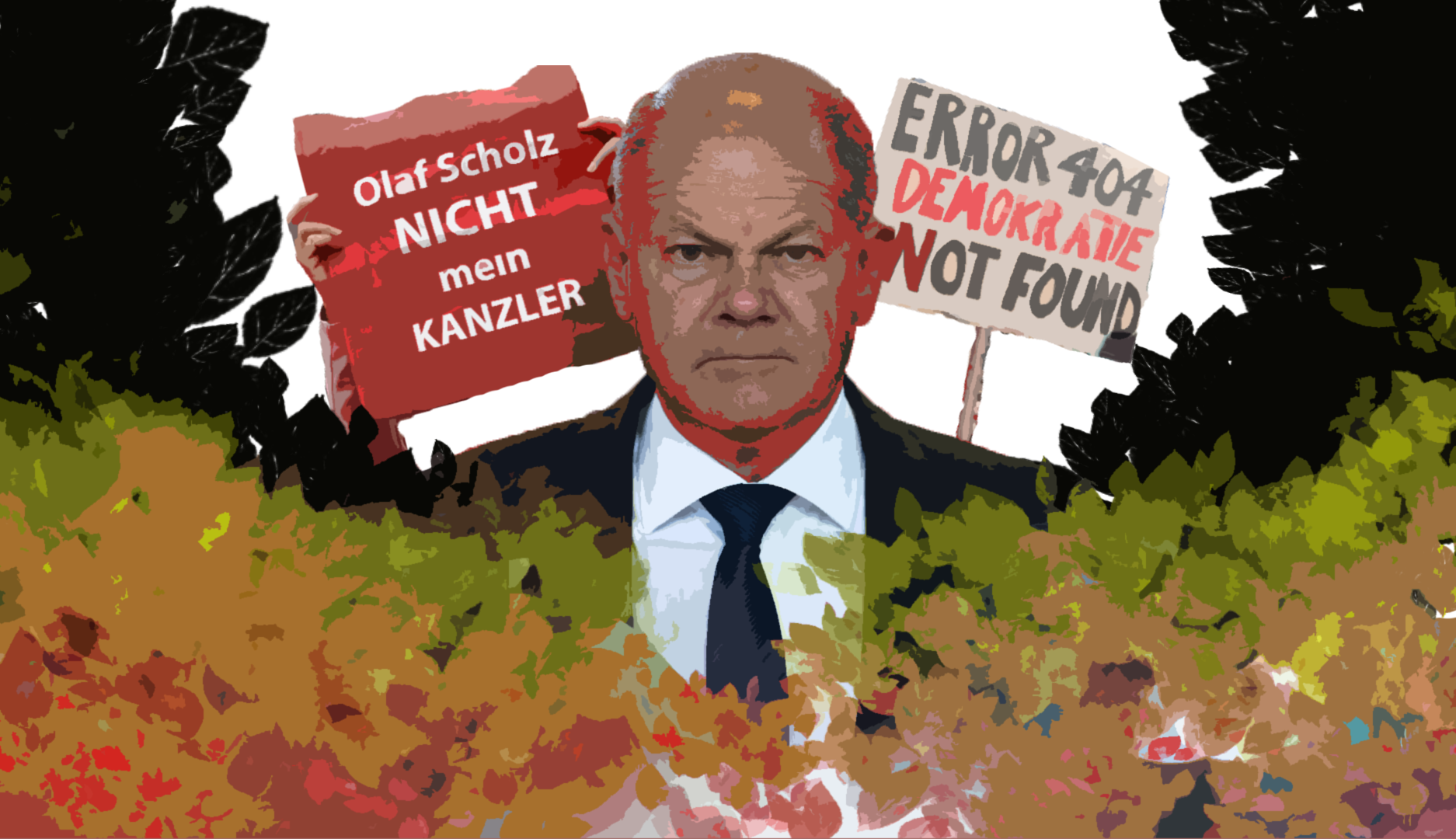
Following the results of the last elections to the European Parliament from Germany in early June 2024, Germans practically declared a nationwide vote of no confidence in the ruling coalition and Chancellor Olaf Scholz personally. The parties in the ruling “traffic light” coalition (SPD, Union 90/Greens, FDP) lost. With 13.9 per cent of the vote, according to preliminary results, the Social Democrats showed the worst result in the national election. “The Greens slipped to 11.9 per cent, the FDP got 5.2 per cent.
Three out of four German citizens are dissatisfied with the federal government, and the ratings of the parties in the ruling coalition have long been low, according to opinion polls conducted at the end of June 2024. But the results of the European elections have pushed them even lower. Meanwhile, the right-wing populist Alternative for Germany party did better than the ruling parties, with 15.9 per cent.
The clear winner in Germany’s European Parliament elections was the opposition conservative CDU/CSU bloc, which won a combined 30 per cent of the vote. The Christian Democrats’ plan to demonstrate national sentiment through the European Parliament elections paid off.
After the election, Christian Democratic Union (CDU) leaders Friedrich Merz and Christian Social Union (CSU) leader Markus Söder even called for early parliamentary elections in Germany. The European Parliament elections were evidence that the “traffic light” coalition was “unelectable” and “a clear vote of no confidence in the chancellor,” Söder said in Munich and emphasised that Scholz no longer has legitimacy or credibility among the population.
However, early elections to the Bundestag are not being discussed at all within the “traffic light” coalition itself. “We haven’t thought about it for a second,” German government spokesman Steffen Hebeestreit stressed at a press conference on 10 June. In Germany, the next parliamentary elections are due in autumn 2025. “This is what we plan to realise,” Hebeestreit said.
This unwavering stance of the government coalition is probably due to the fact that the federal chancellor could lose his post if early elections are held. Unlike in the case of French President Macron, who managed to be re-elected in the recent early elections, Scholz does not intend to risk his position, because Macron was directly elected by the people and holds office until 2027, while the German Federal Chancellor is elected by the majority of the Bundestag.
The elections to the European Parliament in Germany are traditionally regarded as a “litmus test” for predicting the subsequent results in the Landtags and the Bundestag. The results of opinion polls show that in the east of Germany, in the states of the former GDR, the right-populist “Alternative for Germany” is leading by a large margin. In the western states, the opposition CDU/CSU bloc is in the lead, but its position is not as strong as that of the AdG in the east.
Intra-party and intra-coalition disputes
One of the most pressing foreign policy issues for the coalition is military support for Ukraine in confronting Russian aggression. Since the beginning of the conflict, the coalition’s position has been unchanged: full support for Kiev and a tough sanctions policy towards Moscow. Obviously, the chosen political course is not bearing the fruit the government had hoped for.
Apparently, sensing the mood among voters, who supported the position of the ruling coalition at the beginning of the crisis, the conservative CDU/CSU bloc has changed its attitude to the problem. Some politicians of the bloc openly advocated the cancellation of social assistance to Ukrainians of mobilisation age in Germany. And Saxony’s Prime Minister Michael Kretschmer, a member of the CDU, spoke in favour of halting the supply of military aid to Kiev and Kiev’s renunciation of some of its territories in order to achieve peace in Europe as soon as possible.
To the surprise of the ruling coalition, Scholz’s running mate, Brandenburg Prime Minister Dietmar Woidke, openly called on the chancellor and his government to make more diplomatic efforts than they have so far to bring about a ceasefire in Ukraine.
Meanwhile, the opposition parties Alternative for Germany and Sarah Wagenknecht’s Union have made peacekeeping in Europe the basis of their political platform.
At the same time, relations between the SPD, the Greens and the FDP are increasingly tense. Political disputes within the coalition occur constantly and it has long been obvious that the parties have different political interests. The latest example of intra-coalition disagreements was the draft federal budget for 2025. The main problem was the resulting “hole” in the budget, which needed a compromise to close. And a compromise was found. Approved on 17 July after months of discussions and hours of consultations, the draft federal budget of the Federal Republic of Germany for 2025 halves military aid to Ukraine to 4 billion euros. The decision drew criticism from both the opposition and the supporting electorate and partners: the impression was that the government tried to “sit on two chairs”, but in the end it miscalculated and adopted half-measures.
The gas pipeline explosion undermined the Chancellor’s credibility
The recently published results of the investigation into the undermining of the Nord Stream and Nord Stream 2 pipelines in September 2022 have been another blow to the credibility of the Chancellor and the government as a whole.
Following an investigation by the German prosecutor’s office, the persons who planned and carried out the bombing became known. The involvement of the Ukrainian authorities at the highest level was announced. The Federal Prosecutor’s Office issued arrest warrants for the participants. One of them was in Poland at the time the warrants were issued; however, the Polish authorities refused to extradite the Ukrainian, citing formal reasons.
Despite direct evidence of Kiev’s involvement in the bombing, representatives of the German government said that “this will not affect the FRG’s support for Ukraine in any way.”
Obviously, the opposition forces in Germany have received another reason to criticise the Scholz government and the rating of the ruling coalition has once again dropped.
Thus, the political situation in the FRG is in a high degree of tension. It is highly probable that the upcoming Landtag elections this autumn and the Bundestag elections next year will completely change the political picture inside the FRG. There is no doubt that if the ruling “traffic light” coalition continues on its current political course, the coalition will not be able to remain in power next year.
Peace.
Love.